January 15, 2026 EDIT: "Play Haydn's "Divertimento in G Major" Your Way" is now live! You can continue to discuss your preparation of the piece here. The next PIYW will be announced January 16.
PIYW #5: Play Haydn's "Divertimento in G Major" Your Way
Play It Your Way is a quasi-monthly event for beginners, professionals, classical, jazz, or pop pianists and everyone in between! We are starting work on Joseph Haydn's Divertimento in G Major (Hob XVI:8). Use the links below to find the sheet music, pick the movement(s) you want to play, and when you are ready, post your performance in the submission thread. Perfection is not expected!
Previous PIYWs:
Play "Beale Street Blues" Your Way
Play "Pachelbel's Canon" Your Way
Play "Autumn Leaves" Your Way
Play "We Wish You a Merry Christmas" Your Way (as part of the Winter Holiday Recital)
Thanks to keff for this month's selection! Please suggest pieces for future "Play It Your Way" events by using the suggestion box. The theme of the upcoming PIYW (to be announced in January) is Popular music, but feel free to submit good ideas across all genres. (Ideally, the Play It Your Way piece will be playable by many different skill levels, but it doesn't necessarily have to be.)
Guidelines
- This is not a contest! It is meant to be a casual and fun event.
- A new "Play It Your Way" piece will be announced on the 16th of the following months: Jan, Feb, Apr, May, July, Aug, Oct, Nov.
- You can use this thread to discuss your preparation of the piece, or anything else related to PIYW. To submit a recording of your performance, go to the submission thread.
- All PIYW submissions will remain hidden from public view until two months after the announcement (January 15). However, there is no deadline for when you need to submit your performance. You may submit a recording at any time, including before and after that date.
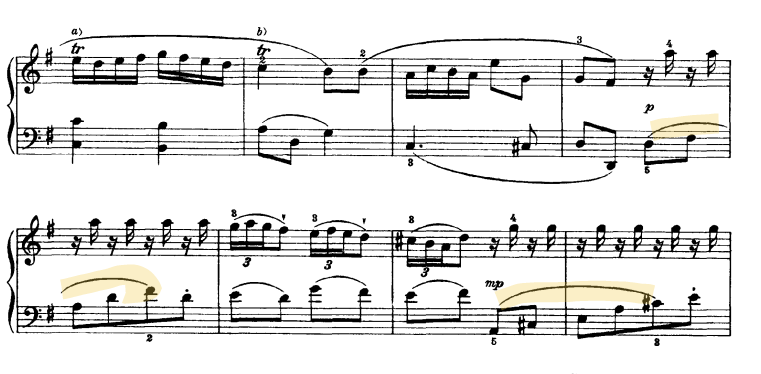
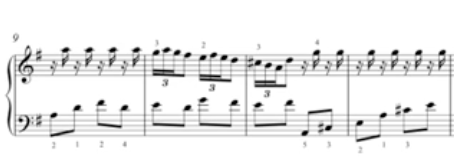
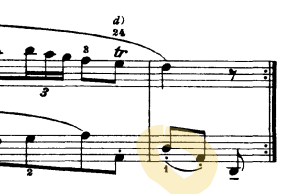
Divertimento in G (Hob XVI:8) by Joseph Haydn (1766)
From the Wikipedia page:
The keyboard divertimento resembles the sonata, but its purpose was more for entertainment. Haydn’s divertimentos tend to have three movements in a quick-slow-quick form.... Georg Feder groups this divertimento with nine others, calling them, “Nine small early sonatas.” Feder believes Haydn wrote them for his students or amateurs, as they are not technically challenging.
The piece is scored for harpsichord. The first movement is an abbreviated sonata form in 2
4 time, and is 44 measures long. It follows the pattern of modulation from tonic to dominant in the first section, with a ten bar central section before the recapitulation of the original material in G major. The movement is lively and has a two-voice texture. It presents rhythmic challenges such as triplets surrounded by duplets and off-beat patterns, and also features contrapuntal lines and sixteenth note triplets. The second movement is a minuet without the trio, in standard 3/4 time, and is a brief 16 measures in length. It has rhythmic complexity; in the first four measures half notes, quarter notes, eighth notes, eighth note triplets and sixteenth notes are all encountered. The third movement is a short, 9 measure andante in common time, where the first half of the piece is composed of four bars which are repeated once, and the second half comprises five bars which are also repeated. It is melodic and well balanced and also features contrapuntal lines. The allegro finale is in 3
8 time and is 24 measures long. It is also composed of two halves, which are both repeated once. It is described as a fast and jocund movement, and is a good study in finger independence and facility. It features broken interval figuration, octaves, and both sustained and moving notes.
Links to Sheet Music / Lead Sheet
- You are not limited to only the music linked below. Feel free to find or create your own version.
- You do not have to play the whole piece--you can just pick a single movement.
- Keff reports that the ASBRM grades for movements 1-4 are are 4, --, 3, 2 respectively. I would estimate Movement 2 to be Grade 1.
- You do not have to complete or perfect the piece to submit it, and don't be afraid to simplify or shorten the piece.
- Improvisation, backing tracks, and backing humans are all allowed.
Sheet Music (IMSLP link)