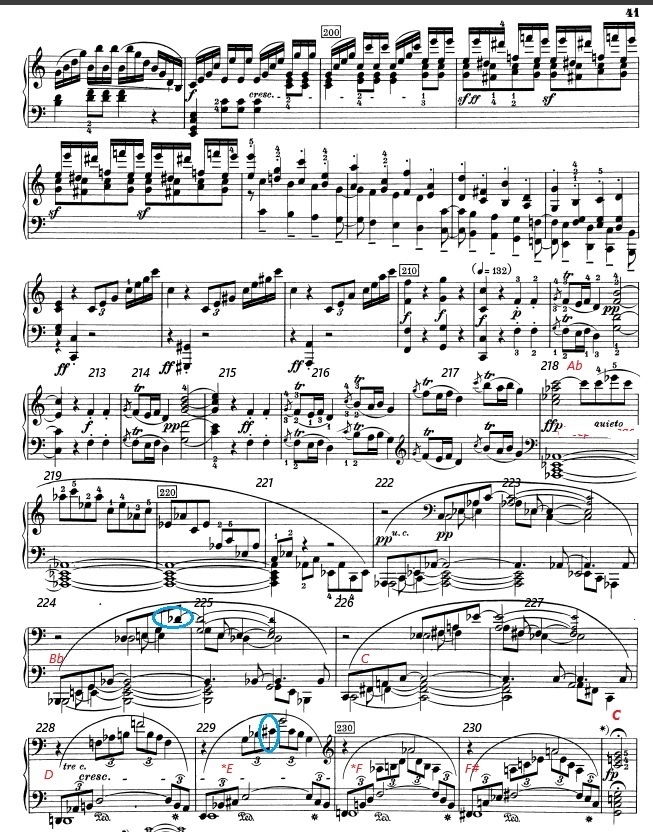
Thank you, @Sidokar . I found the piece and relevant part and am featuring it on the bottom for reference. I've used Paint to number the measures and write in things in red and blue. In my score the dim7 chords start in m. 224, walk up a whole tone as you indicated Bb, C, D (notes) until we hit E and then goes by semitones which would also make this part more intense to my ears, until it resolves to the C chord. It's an interesting ride! I've circled the Db and C# respectively in blue. This is the "same chord", but there would be a reason for the choices, and I'm thinking that since the 2nd time it's about to ascend a semitone "where it goes next" is the factor.
Sidokar thus you cant analyse it and put roman numerals that would have a sense for that period of music. ..................................
......... The notation simply reflects at best the proximity of notes from a contrapuntal point of view.
Contrapuntal, the movement of each voice horizontally even though we don't have voices properly speaking - I think that's what I was feeling my way into before. When I did my little exercise, I had the potential various spellings of each pitch of a given dim7 chord, and then where it's going and simplicity became the guiding idea; after which I ended up with a properly spelled dim7 chord (as it would be in some inversion).
Sidokar The way it is notated is not "correct" in the sense that it does not reflect any particular key; the first one should be (when starting with a bass note of B flat) B flat - F flat - A double flat - D flat.
This was another matter often discussed about this type of chord and the narrower way in which it seems taught, where it must be this or that proper chord which can be written as stacked m3's as the root, and then the inversions thereof. By what you say, this may be tied to tonality, Roman Numerals, and the rest - where in a passage like this there can be no such thing. I also did not label the chords for that reason - simply wrote in the progression from the bottom note.
If I remember my theory right, the "proper" labeling of those chords would be (hopefully I won't mess up along the way):
m. 224 E dim7 / Bb; m. 226 F# dim7 / C; m. 228 B dim7/D; m. 229 C# dim7/E; m. 230 B dim7/F; m. 231 F#dim7
i.e. all of them as "inversions" except the last one. That doesn't seem very useful, and it would lead to thinking "which inversion of official dim7 chord names would I use?" (the thinking I abandoned). The alternative, of naming them according to the bottom note in "root position" would create the nightmare you described. I like the "contrapuntal" idea.
I understand that in jazz theory, a diminished chord is simply labeled by the bottom note regardless of spelling. But between different conventions, I'd hesitate to give any label. The first chord would be Bb dim7 by the jazz convention if I understand that right, and E dim7 / Bb by the other convention if I have that right.
Back to this part:
Sidokar thus you cant analyse it and put roman numerals that would have a sense
Emphasis on the "analyze" for the moment. Why do we analyze, other than to pass theory exams? 😉 I'd think, for navigating the music we're playing. If I see I IV V7 I in any key and have that in my bones, then the job's half done already. Where function and key matter here is the greater context of being in C major; the surprise chord of Ab, return to C. For the other part, what I want to perceive is "dim7's ascending by whole tones, then semitones. And I want to see it as simply readable as possible.
Sidokar I think B is trying to stay as simple as possible avoiding complicated notation and staying within the A flat/C key notation (with F sharp being the leading tone to G). He ends the sequence with F sharp - A - C - E flat which is the Dim7 in G followed by C 6/4 and we are back to a Dominant of C.
Yes. This has been a fascinating and instructional example. I've been rather nerdy about this, but maybe it's also useful to someone besides me.
Sidokar You could write that same sequence with a different notation, if you choose another point of view or if you write the chords in a different configuration than B. If you listen to that passage, it is from an audible point of view an obvious sequential passage that has only a purpose of creating a moment of harmonic transition before going back and ending the coda and the piece in a standard C major.
That makes total sense. 🙂