I'm going to go weird and far afield for a moment. It's not the main direction I wanted to take when I started this thread, and it still isn't. It was triggered in part by Piston's statement bringing in the dominant and a weird left field encounter with Rameau. Bear with me.
Harmony theory, when I was learning it, seemed to be largely based on major scales the degrees derived therefrom. Chords were "functional", tying in with this, everything leading back to the Tonic or "deceptively" briefly to the "vi" degree. There was the I V I, expanded to I IV V I, with modulations with a V/V or similar to get us right back into that same pattern, with extensions, temporary excursions. It's useful because a whole ton of music goes that way. Nonetheless, our chords seemed to always be slotted into these functions, like Peter is never just Peter, he's a fireman but may moonlight in another role - there's always a role. I'm simplifying, of course. Some of the theory books had tiny "notes to the teacher" in footnotes saying that all this pertains to Common Practice music, and this and that didn't always go that way.
Enter new information on Rameau. I knew him as the fellow who put our ideas of chords together, sort of the father of it all, though likely not alone. I didn't know the "just before" part. I mean I did know about counterpoint: the single note chants turning into two voices, then three, while trying to sound not dissonant. You don't want two voices to sound ugly; when they're an octave or a 5th apart they sound smooth, and then the 3rd added to that also sounds smooth. If you blend three or four voices singing these "smooth" intervals, you end up with a major or minor chord even though the idea of "chord" hasn't been invented yet.
Further: as they were chasing these smooth sounds, and effects, there were other aims like a tonal center and a lot of other things that go with music. There were lots of rules and patterns to learn, musical awareness to be honed, in extensive training. If I recall correctly, at the time of Rameau they were trying to churn out a lot more musicians and it was getting impossible to give them all that level of training. So it seems that Rameau translated all those rules into something handier and a different kind of paradigm, and this was the chord, the functional chord, and the rest.
This leaves me with at least one basic thought: That there are two very different ways of perceiving what we are doing in music. If Rameau and those after him packaged everything into chords and functions, is there also a completely other way of looking at all of it? Can the ideas of function and chords become a handicap, where we tie ourselves in knots trying to always see the notes within that kind of context?
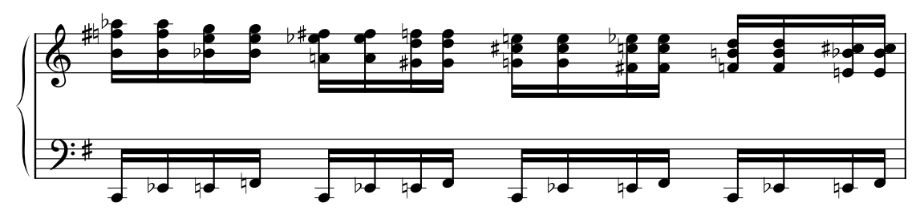
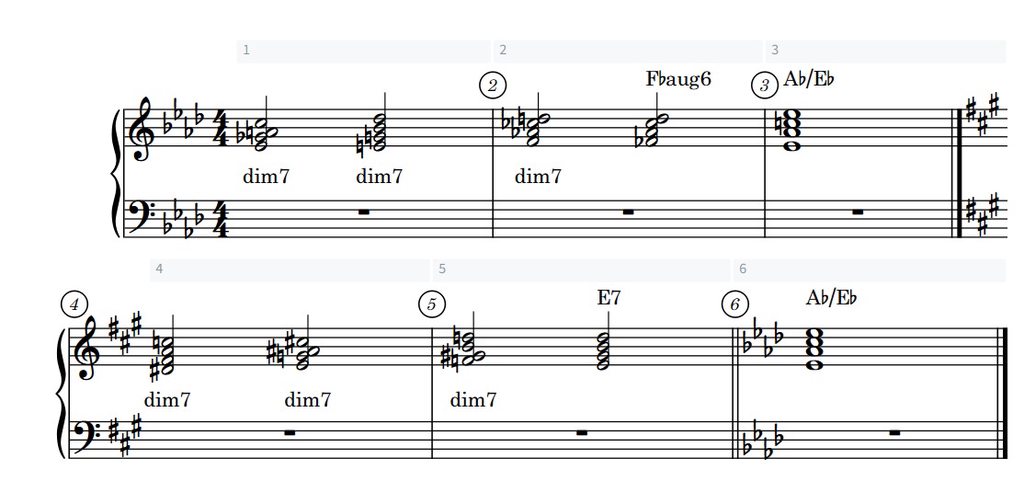
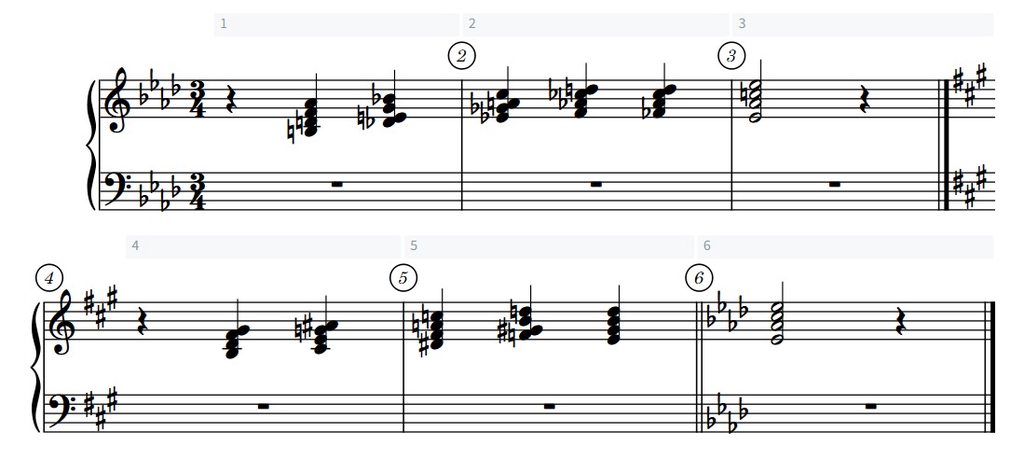
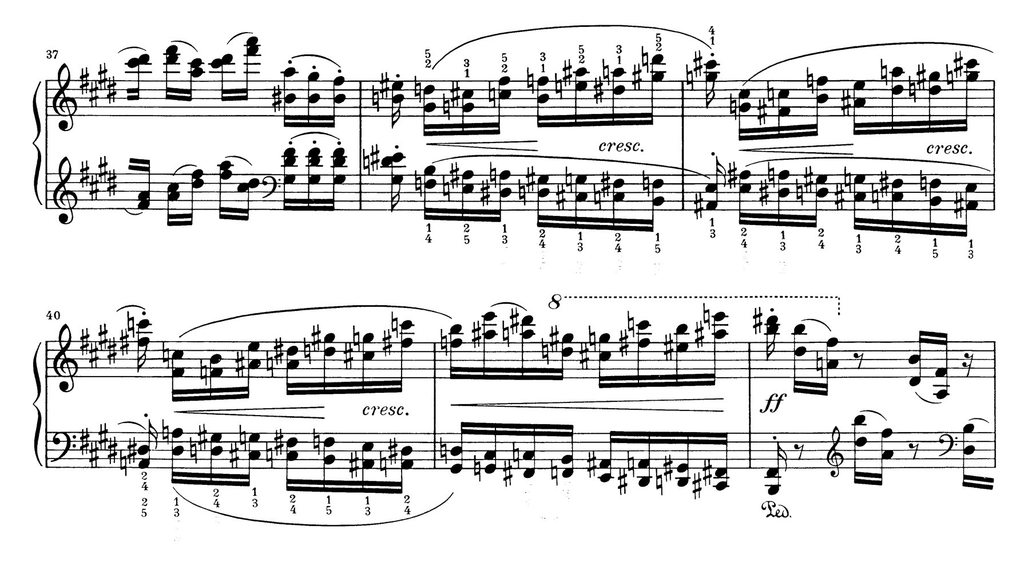
When I started the exercise, I initially drew in all the forms of a dim7 chord that I knew, some being in inversions so as to get my chromatic bassline as it were. I then abandoned any notion of chord, went pitch by pitch of a given dim7 chord using either flats in a flats signature or sharps in a sharps signature for "non-white" notes, and "white notes" for the rest - giving the same thing as in Chopin's example. The result ended up being legit dim7 chords that could be restacked in minor thirds, but I didn't work that way. It was almost like reverse-engineering what I understood to be Rameau's trajectory. @MRC - when you looked at Piston's quote about dominant, you saw complicated looking chords resulting from that approach, versus what Chopin did. The "dominant" idea would bring us into the world of chords having functions.
I think in the first place, since I knew there were two (or more) ways of looking at things, that may be why instinct had me look for what (if anything) was taught about this traditionally.
I don't know if any of this makes sense to anyone.