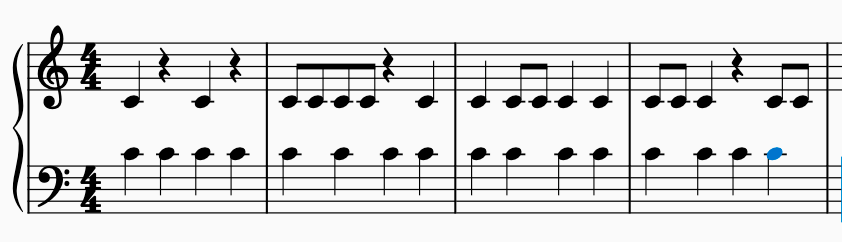
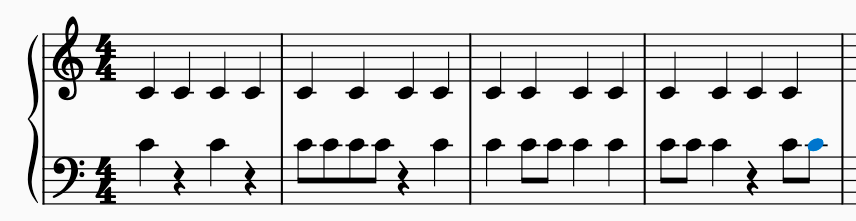
Sophia don't know keystring, but I'm sure @tony_stride who created the method and started this thread would be willing to elaborate 🙂
I actually put that out there for Tony. 🙂
I've studied with and also explored teaching ideas with a senior teacher for quite some time now. One element is the giving of reading skills. That can be easily fudged by giving students music in "C position", "G position", making sure that this is the music they read, so that weaknesses don't show up. But for real reading skills there are a number of things that you want to have happening. (Presently there's a thread where someone sees changing clef signs as problematic).
One thing we want to build is a reflex where you associate the top staff for the RH, bottom staff for the LH, or in other conventions, you have stem-up, stem-down for voices. The exercise in question sort of un-trains this.
We need both flexibility and rigidity. The dyslexic who mixes up p q b d is able to see that "ball and stick" shape numerous ways. "fat" and "taf" may be indistinguishable because s/he can read this both ways. I have a degree of this but didn't realize until I studied learning disabilities postgraduate after my teaching degree and hey, that's me and in my family! I can see "punos" as "sound" (upside-down it is - try it. 😃 ) It took me a long time to handle looking at the keyboard because the symmetry threw me. I had learned by sound and touch (I now realize).
Two other points of flexibility are movable Do solfege, and registers. Since my world was movable Do, I could play (sound out) music in any key and not be thrown if it was in the wrong key. This hampered my ability to read music that wasn't diatonic and predictable because you must see D below the treble lowest line as the key between the two black dots. Registers ---- I sang the music, and if it became too high or too low, I just switched down or up. That flexibility made me lose sensitivity to register and I could easily play something an octave too high or low and note notice.
You want to build some very concrete associations. And that is what bothers me about that exercise. We're in the teacher forum so I'm looking more deeply into this.