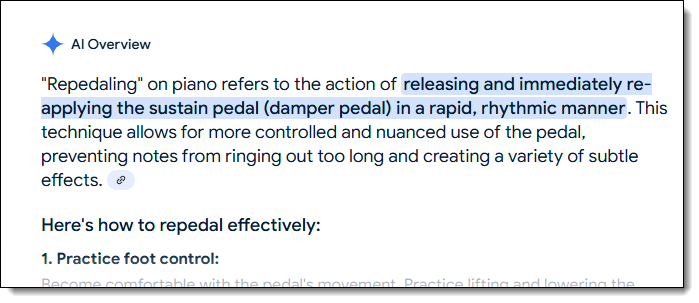
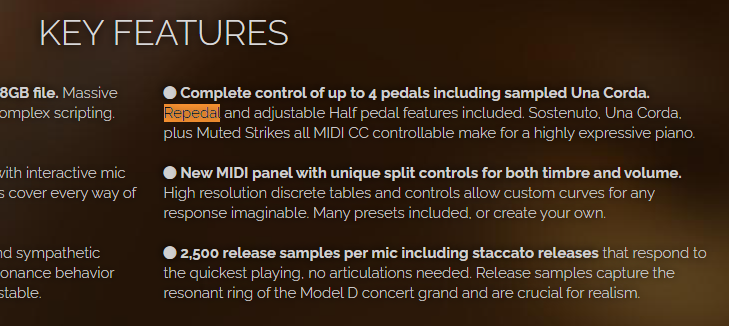
Jane I think what you're describing is what many people call "re-pedal".
This might be part of it. I sent my recording to my teacher and got a quick response that suggests that I only had half of the story. What I recorded was simply the ability to do a rapid enough pedal that would allow the sound not to be erased all the way. If you do it too slowly, the sound vanishes. You want the damper to touch the strings cutting part of their vibration but not all of it. That's the part my old exercise must have been about.
From your quote, what I did was not "rapid, rhythmic" (might that be flutter pedal?) - but a single tap. It sounds weird if you do it right after hitting the note (like I did) because you have a loud burst followed by the soft sound. But in the music I did back then, I wanted the bass note to still be heard, but not as loudly so in the new measure it continued but more quietly.
What I'm thinking, as we consider pedal, is that we have two elements. The "half pedal" has to do with the degree the dampers are on and off the strings. "Quick pedal" is a pedal change where the damper touches and releases quickly - how long the dampers are down before being raised. It gives us another thing to play with.
One limitation of the piano is that once a note is struck, we cannot control the continuing sound, whereas in wind or bowed strings, you can let the sound get louder or softer. The piano note simply decays. It seems we can control that decay somewhat (but we can't effect a crescendo).