BartK I suppose you don't notice that until you have to write key signatures by hand. 😉
Lol! This I actually knew from the beginning. But if I look at the F#, it is the top line of the treble staff. As a beginner, this isn't the F you begin to read. The first F you encounter is the one above middle C. On top of that, a note-head is a ball. A ball in the size of two lines on the staff, very easy to read in value. The symbols # and b are bigger and do overlap a lot more with the lines. For instance, on the b-symbol, not the center of the symbol is the location. It is the center of the o-ring of the b-symbol. My brain doesn't connect accidentals to a note-name, like a note-head does.
If I see something like this, it is always a little bit of a guess work, what note-head is meant by the accidental:
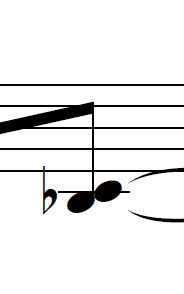
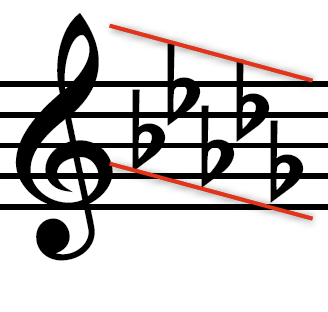
Edit: But as you mention it: This explains why the accidentals are always ordered in a zig-zag shape, and not just randomly placed: (Before that, I always had the impression, this zig-zag ordering is used to save space on the paper, haha)
BartK Such tricks are good at the beginning but the goal should be to know which sharps/flats are in the key signature automatically.
Yep - but it is still more helpful than learn to read notes with tricks like the "landmark system". Know your Cs and Gs in treble clef. Know your Cs and Fs in bass clef. Then you can count the missing lines. Or the "GBD FACE" trick. Not any helpful for sight-reading. It just replaces a lookup-table. But I feel more than 50% of all YouTube videos sell those tricks as the holy grail to beginner sight-readers.
BartK However, if there are accidentals that modify the key signature this is where things get more complicated. There are often chromatic notes that are not within the diatonic scale and then the automatism of the scale notes doesn't work and you have to consciously keep track of which notes are changed.
Haha, tell me something new! 😁