I’m Harry Likas, a jazz pianist and teacher in Berkeley, California. Much of my teaching focuses on helping pianists who can read music but aren’t sure how to turn a melody and chord symbols into a solo piano arrangement. I was the technical editor for Mark Levine’s The Jazz Theory Book, contributed to The Jazz Piano Book, and studied with both Mark Levine and Barry Harris.
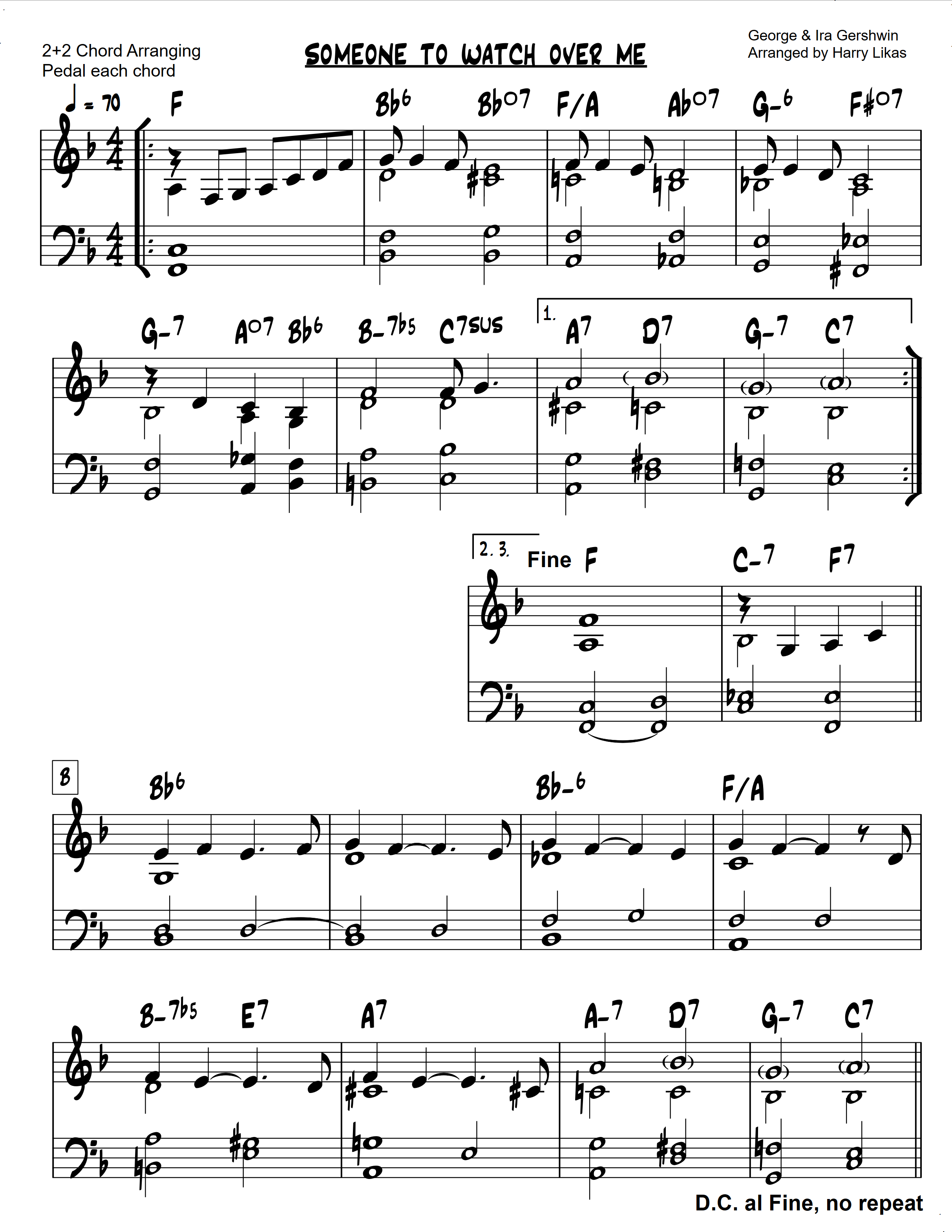
Attached is my arrangement of “Someone to Watch Over Me,” using the 2+2 Chord Method I teach on my Patreon page and in my eBook Vol. 2 — The 2+2 Chord Method: How to Play from a Fake Book.
The basic idea is two notes in the left hand and two in the right, with the melody on top. It gives you a manageable starting point for playing standards from a fake book. As you become comfortable with it, you can vary the texture, add movement, and make your own choices as you play. The goal is to help you create your own arrangements directly from a melody and chord symbols.
At Patreon.com/HarryLikas, you’ll find more than 1,500 arrangements of standards, most using this approach. There are free samples to browse, and the $10 monthly membership includes access to the arrangements, instructional posts, and the complete 158-page Vol. 2 eBook.
The book begins with just one note in each hand—melody in the right and bass in the left—then gradually adds harmony and movement. Lead sheets appear alongside complete arrangements so you can see how the accompaniment takes shape. Familiar tunes return throughout the book, letting you concentrate on each new technique without learning a new song every time.
Later sections explore fuller chords, walking bass, stride, flowing left-hand arpeggios, bossa nova, and ways to add melodic fills, introductions, and endings. There’s also guidance on swing feel and articulation, chord symbols, music theory, and daily practice.
For those interested in improvising, I’ve also written Vol. 3 — The Improv Game: How to Improvise on Piano, a 144-page eBook available for purchase in my Patreon shop. It begins with simple warm-ups and an eighth-note game, then explores connecting scales and arpeggios, aiming for chord tones, and shaping phrases. The emphasis is on getting these sounds into your ear and fingers so you can experiment and make them your own.
I hope you enjoy playing the arrangement.