I know enough music theory to be dangerous.
One of the obvious things about chords, their progressions/cadences and inversions is that they figure heavily into pre-modern western music as we transition from phrase to phrase (or sub-phrase) in the Baroque, Classical and Romantic eras. We begin moving away from that in the Impressionist era.
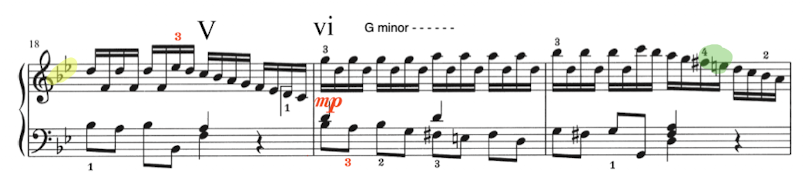
I was really having trouble with this bit in Handel. I knew enough to say OK, we're transitioning from B-flat major to another key, but I didn't bother to articulate which key and how it related to the home key. Nor did I take the time to do the scales and cadences in that key. I thought I'd just fiddle around with the transition and rely on reading skills for the rest.
So, when you do chords starting at the root of the scale of a key and move up maintaining the sharps and flats, you get I, ii, iii, IV, V, vi, diminished vii and back to I, the capital letters indicating the flavor of the chord (upper-case roman numerals are major, lower-case minor.)
I learned this in orchestra, our conductor is a music theory nerd.
Well, I finally pencil whipped the details after thinking about it. In this section, we end a B-flat major phrase not with a cadence back to home but to a V chord (F-major) and then scale down to vi (G-minor chord) and then continue in G minor (the f-sharp makes it harmonic, but then there's e natural, so maybe it's modal, my music theory fades out here) for several measures before ending with a d minor and using the middle note of that chord and running up in a B-flat major scale (home key, yay, we made it) to the next section and finale.
Does all of this theory make playing it easier? Actually, yes. It makes those transitions more secure knowing where I'm ending up. Even more so given the extended G minor (modal?) passage. (Music teachers/theory geeks do not hesitate to correct me...oh wait, who am I talking to here, of course you will!)
So, I just practice the scales, chords, cadences and inversions in those keys and recognize the transitions as a means of getting from here to there!
I promise, it really is worth doing this.