Animisha On Vidal's product page, there is a section describe it's sensor design:
High-Resolution Velocity Sensors
Essential to the responsiveness of a digital instrument are its velocity sensors. As with everything on the Vidal, we designed our own sensors and electronics from scratch. Using a STM32G0B0 microcontroller, the Vidal scans the keyboard 10,000 times per second, capturing hi-resolution velocity data that’s encoded through standard MIDI signals.
Our sensors use a traditional contact strip design, where a precision-molded contact strip with two separate conductive pads press on the sensors on our PCBs in sequence, and the timing differential between these two presses is used to calculate note velocity. We opted to use this kind of sensor design due to its reliability and simplicity; this same contact strip design is used on nearly all digital pianos on the market today.
The Vidal sends hi-res MIDI data for both note-on and note-off events, and supports continuous pedaling via compatibility with single-TRS triple pedals.
If I understand this correctly, they are using a dual-sensor design. However, the majority of DP nowadays implements triple-sensor for good reason - it allows sounding the same note again without having to fully release the key, for faster repeats.
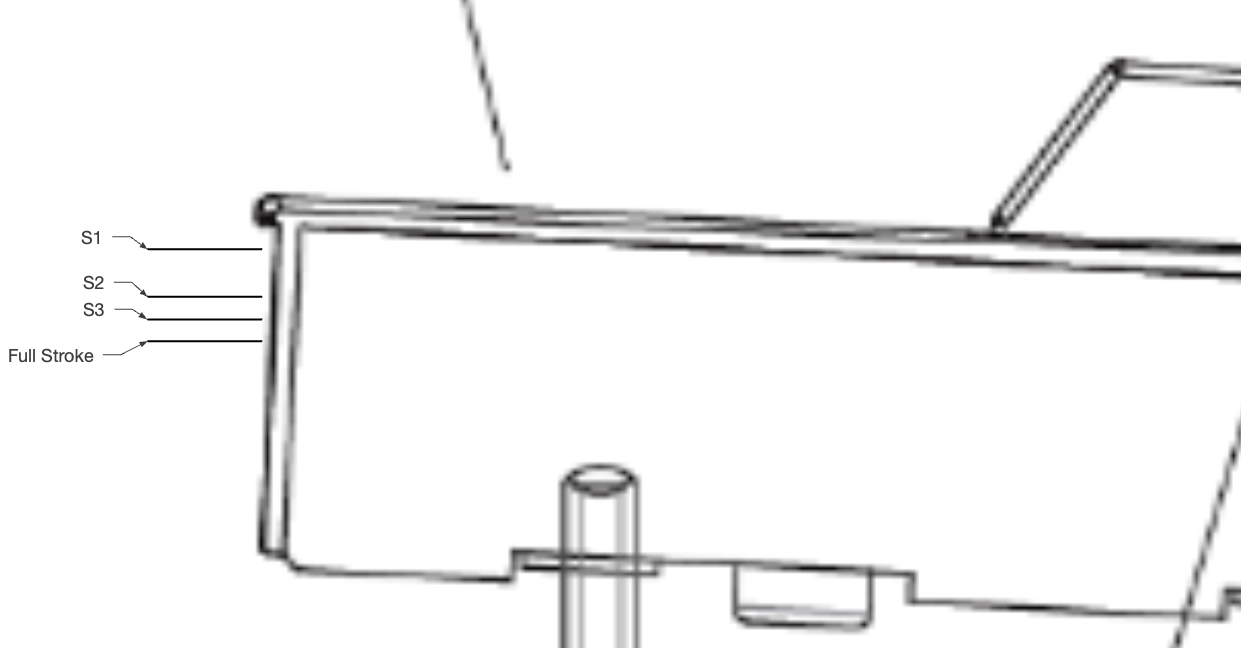
The illustration in @CrisOliveira's post explains how triple sensors work. You do need to understand contact sensor can only tell the time at which the key triggers it. To obtain velocity measurement, the key must trigger two sensors - velocity = distance / (sensorB time - sensorA time). In addition, the top sensor S1 must be placed high because it's the point to simulate the exact time when damper falls back onto the string and mute the sound. The bottom sensor S3 also must be place low where the let-off point is. Without S2, one must release the key all the way up to S1, then press down to S3 to trigger a repeat of that note.
What's not accurate in that triple-sensor illustration is the placement of S2 sensor. In reality, S2 is much lower and closer to S3, as shown in this illustration I made of MP11SE's GF1 action based on published tech spec.
To be honest, I cannot fathom how Vidal get around the fast repetition limitation of dual sensor design. Wouldn't they have said something if they found a clever workaround? Without a workaround, this could be a deal-breaker in my book.
