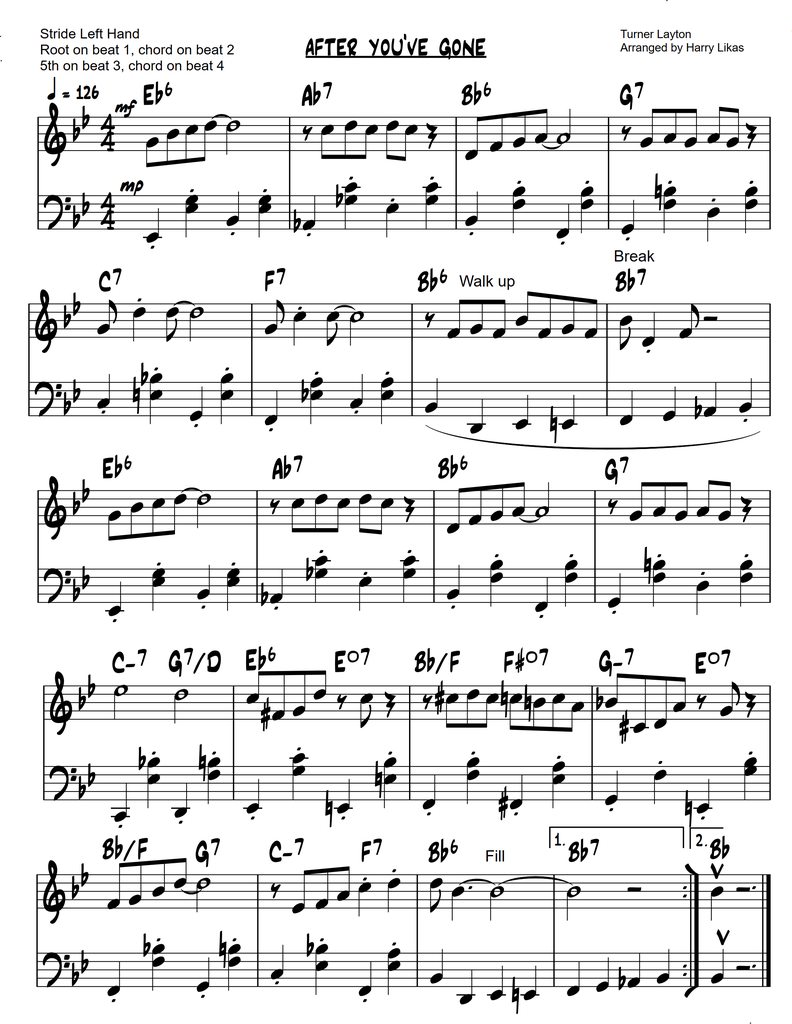
"After You've Gone" piano arrangement
"After You've Gone" – Here are several ways to articulate a stride left-hand pattern:
- No Pedal – Play each beat detached without sustaining.
- On-Off" Pedaling – Press the pedal on beats 1 and 3, release on beats 2 and 4.
- Pedal Every Two Beats (smooth) – Press the pedal on beats 1 and 3, holding through beat 2 and 4, then change with the next bass note.
When developing a stride left hand, it’s common at first to rely on looking at the keyboard to manage the large jumps between bass notes and chords. But over time, with practice, the hand begins to move accurately without needing visual confirmation. A key part of this progression lies in the geography of the keyboard itself — particularly the black keys, which stand in relief and serve as tactile landmarks. These raised keys help orient the hand, allowing the player to “feel” their position on the keyboard and guide movements toward white keys. This tactile awareness, combined with muscle memory and the internalization of intervallic distances like octaves and tenths, allows stride to become more fluid and automatic. By consciously using the black keys as navigational aids, a pianist can accelerate their ability to play stride smoothly without needing to constantly look down.
To help pianists become comfortable with this approach and the 2+2 chord arranging method, I've arranged over 1,200 solo jazz piano arrangements, and I've created 65+ tutorials (with new arrangements added daily) at Patreon.com/HarryLikas I also offer lessons for pianists who want to get comfortable with this system or explore the Barry Harris approach to improvisation in depth.
I served as the technical editor for Mark Levine’s The Jazz Theory Book and contributed to The Jazz Piano Book as well.