pianoloverus What does the phrase "add color" mean? At least for me, that phrase is at all well defined or clear.
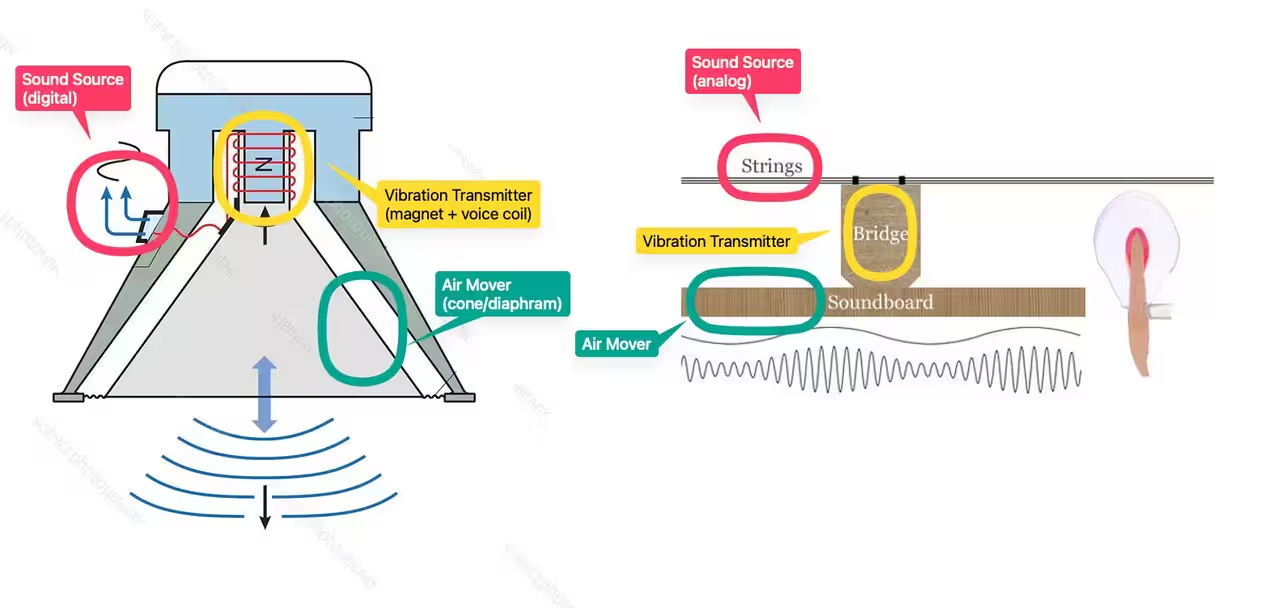
Maybe a different way to ask that question is: does piano soundboard faithfully reproduce the sound generated by the strings? If it does, then in theory one could replace the soundboard in a piano with different wood or construction and the piano would still sound the same. But if a different soundboard do make a piano sound different, then the soundboard is "adding color" to the sound.
In the audio world, "reference speakers" are designed to be "transparent" - they shouldn't change the input sound, and they should be interchangeable. In reality, this is not easy to achieve, and the really transparent reference speakers are few and often expensive. I suspect piano soundboard is far from "transparent".
Thus, the real unexplained factor for the soundboard speaker is this: if the soundboard adds color to the sound, then what sound should the transducer/vibrator feed the soundboard so that the outcome is the desired sound?
Let's take Kawai Aures piano as an example. It's a full size normal upright. In addition, it also has transducers affixed to the soundboard. The soundboard can be excited in 2 ways: by the string via the bridge, or by digital audio via the transducer. If we speculate the soundboard is not transparent, but is some kind of "transformer" of sound, then to output the same sound 2 (what we hear), the soundboard must be fed the same sound 1 (source vibration). That means the digital audio feed should be equivalent to the sound of the string. However, in almost all VSTs, the digital audio sample recorded are mostly made up of the soundboard sound. It's impossible to record the string sound alone even if one close-mic the strings. What this means is the transducer is feeding a soundboard-transformed sound to the soundboard to be transformed a second time. Wouldn't that make the final sound different?
I'd be really interested to hear people who have experience with Kawai Aures or Yamaha TransAcoustics piano to tell if the digital playback in those piano sound exactly the same as played acoustically on the same piano. If they do sound identical, then I wonder what black magic audio engineering was done to achieve that. And whether that black magic will apply equally effectively to both built-in sound engine as well as external VSTs.