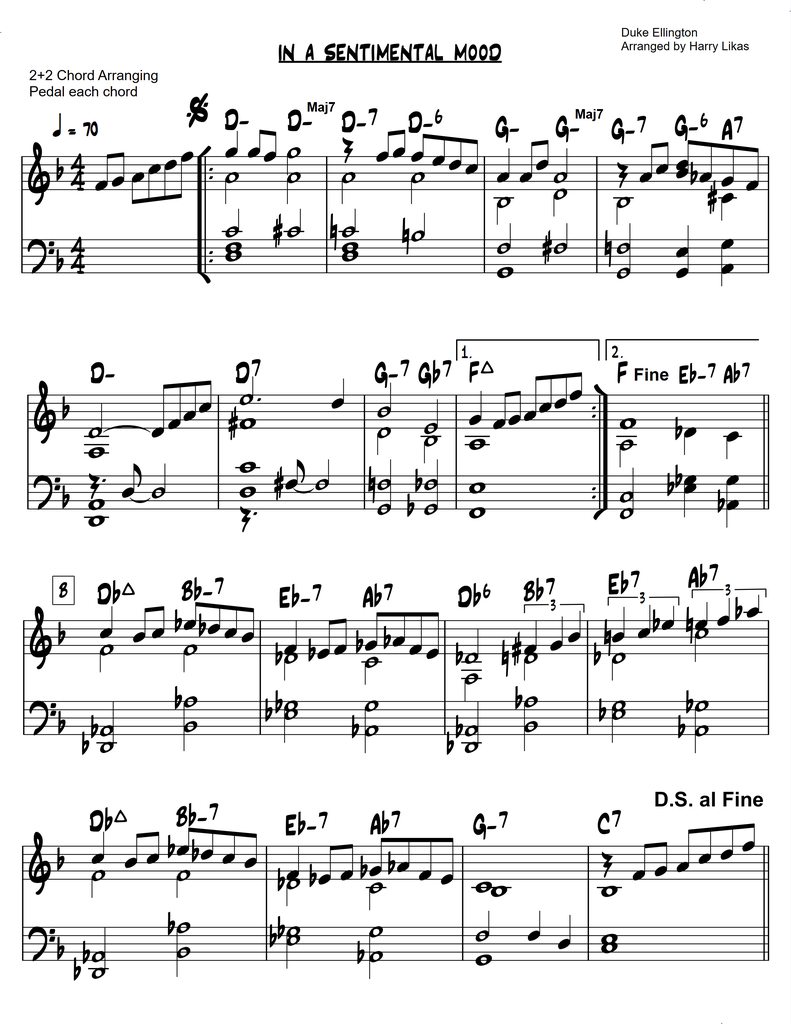
I've arranged "In A Sentimental Mood" using my 2+2 chord voicing method for solo piano.
"In a Sentimental Mood" is a jazz ballad composed by Duke Ellington in 1935. It's known for its lush harmonies and romantic, introspective melody. The tune became a jazz standard, especially cherished in its 1962 collaboration recording between Ellington and John Coltrane, which added a deeper, modal richness. The piece evokes a nostalgic, dreamy atmosphere and is often performed as a slow, expressive ballad.
For students just beginning to learn how to form chords from chord symbols—a challenging and often overwhelming step—the 2+2 system offers a practical and approachable framework. It removes the guesswork by showing exactly which chord tones to play in each hand, making complex-sounding harmony easier to access.
In the 2+2 system, the left hand anchors the harmony, typically playing the root and 7th or the root and 3rd—and on tonic chords, sometimes the root and 5th. The right-hand thumb fills in the remaining essential chord tone (the 3rd or 7th, whichever isn’t already played in the left hand), while the upper fingers play the melody.
These voicings are comfortable, versatile, and highly playable. They work beautifully in both solo piano and ensemble settings, providing a solid harmonic foundation that frees up the right hand for more expressive melodic ideas and improvisation.
As students progress, they can expand on the voicings by adding 9ths, 11ths, and 13ths, experimenting with left-hand rhythms, and incorporating right-hand embellishments to develop a more personal sound.
I've used the 2+2 method in over 1,200 solo jazz piano arrangements, and I've created 65+ tutorials (with new ones added daily) at www.Patreon.com/HarryLikas. I also offer lessons for pianists who want to get comfortable with this system or explore the Barry Harris approach to improvisation in depth.
I served as the technical editor for Mark Levine’s The Jazz Theory Book and contributed to The Jazz Piano Book as well.
Although 2+2 voicings are the core of my approach, I adapt to the musical context by incorporating a variety of other left-hand accompaniment styles—including Latin rhythms, modern voicings, stride techniques, walking bass lines, Broadway-style bass, and arpeggio-based textures.