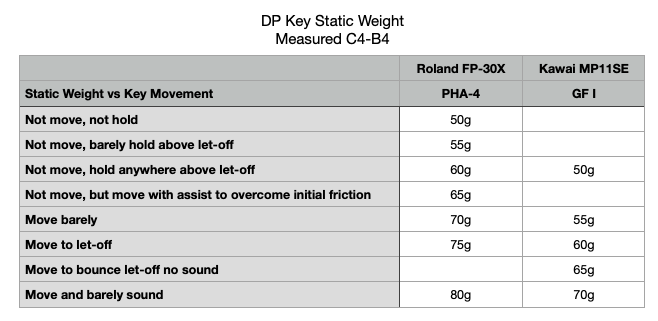
I bought a set of calibrated weights and measured the static resistance of my two digital pianos.
First of all, this is just static weight, or the weight that's moving the keys very slowly. It tells little about how the key feels when played above mezzo-forte where momentum of inertia become a major factor.
Kawai GF1 action is about 10 grams lighter than Roland's PHA-4 action. More interestingly, the GF 1 action, true to its seesaw nature, take very little additional weight to go from not moving to moving. In contrast, the PHA-4 action seem to have extra initial resistance when transitioning from static to moving, but once gets moving, the extra initial resistance disappears and the key moves more freely to the let-off point. The difference between these two actions does confirm my subjective impression that the GF I action has a pleasantly smoother feel.
For the feel when playing at louder dynamics or higher key velocity, I don't know how to measure it, but my subjective feel is PHA-4 takes less finger pressure to produce ff velocity, whereas GF I requires significantly more force to play f and ff. This would make sense if one consider the material used in the action and the resulting difference in mass (or to be exact the moment of inertia): PHA-4 made of plastic and light, vs GF 1 of wood and heavy.