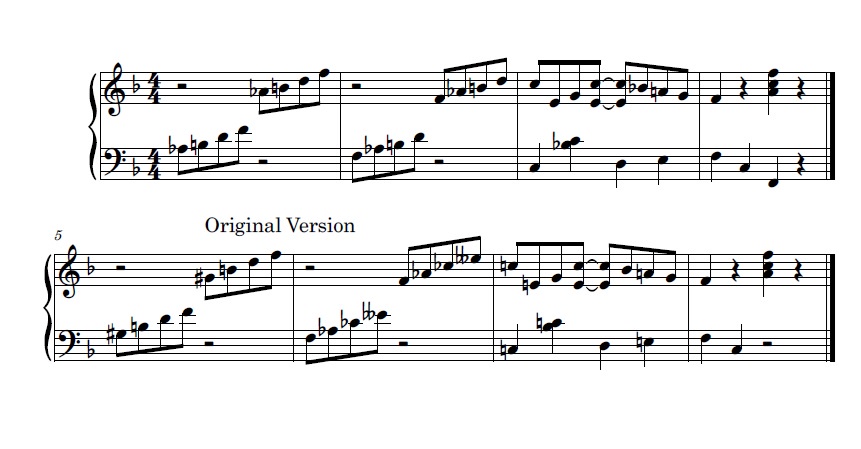
Animisha ....... but I think that for some music theory related reason, Alfred's wanted to write the first two measures as a progression of thirds.
You are right about the "progression of thirds", and I guessed that the first time the two measures were brought up. Seeing the lesson page in full made it even more clear what was going on. It has to do with teaching, and teaching choices. Give a simple (seeming) explanation of a new concept - add to and amend later. As a student I was caught out by this approach several times way back when, and don't like it because you then have to adjust what you thought you knew.
In traditional theory, the dim7 is taught the way major and minor triads are taught: stacked thirds (snowmen) being the "root position" version; and then inversions of "that chord". So what I wrote out would be seen as two inversions of Bdim7. The "root position form" is B, D, F, Ab .... stacked (minor) thirds, skipped letter names. In what I wrote we have the "inversion" Ab, B, D, F ..... The Ab B is an augmented 2nd - we no longer have skipped letter names, but obviously we still have a dim7 chord. Playing it at the piano you can immediately see and hear it.
The book gives ONE definition of the dim7: It skips letter names and there's a minor third between each note. So if they write music illustrating what they defined, they have to stick with that definition. Probably in some future time they'll introduce "dim7 inversions" but for right now, this is what the students have. Therefore (to your initial observation) they forced in minor thirds per that definition, and ended up with that monstrosity with all those accidentals.